The Silent Sellout of American Soils
posted on
November 15, 2026
Good morning from Roanoke,
Today I’m diving into a pretty big topic, one that’s been on my mind for a while.
I’m going to start today’s topic with a personal story: the picture below was taken on September 30th back in 2019.
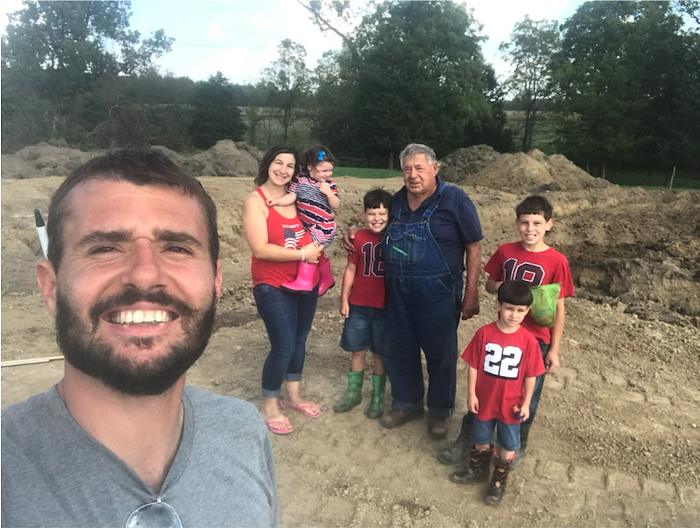
That’s me with my wife, our four kids at the time, and my grandfather. It was the day we broke ground on a lifelong dream of building a house for my family on our farmland.
Being the ambitious younger version of myself, I decided I would be the builder. It nearly turned into a two-year project that involved me in nearly every detail, from the dimensions of every room and window to finding a supplier for every material and a contractor for every job.
By the end, my appreciation for the craftsmanship and oversight that goes into building a house was forever changed.
After finally moving in, we welcomed our 5th child just a few months later. The feeling of connection, satisfaction, and safety was indescribable.
It was a reminder of how easily we devalue something when we become disconnected from the process.
Our culture has become deeply disconnected
We turn on the faucet, flip a switch, flush the toilet, and roll the trash to the curb, and it all just goes... somewhere. And we open our fridges and within seconds we’re eating food we know nothing about, with ingredients we can’t pronounce.
Here’s my point...
Imagine if I had been disconnected from the entire process of building my home. What if I had zero relationship with my contractors and demanded the house be built at the lowest possible price, by the lowest bidders, with the cheapest materials?
That sounds absurd. But folks, it’s not far off from what has happened to food and farming over the last 80+ years.
The difference is that we live in our homes every day. Poor construction shows up fast. With food, the feedback loop is slow.
The damage to our soil, our rural economies, and the nutrition of our food has been compounding for decades, and as a society we still haven’t connected cause and effect.
I believe we’re already at a breaking point.
I’m seeing three forces converging at the same time that is creating a dangerous domino effect.
All three stem from deep layers of disconnection, yet nobody seems to be connecting the dots between them.
The disconnection between people and their food.
This point might be obvious to you already, but hear me out, as it's a crucial setup for the next two forces I address below.
In our grandparents' day, about 1 in 6 Americans lived on a farm. Today it's about 1 in 100.
Almost every modern American family personally knows their dentist, doctor, attorney and car mechanic. But nobody knows their farmer.
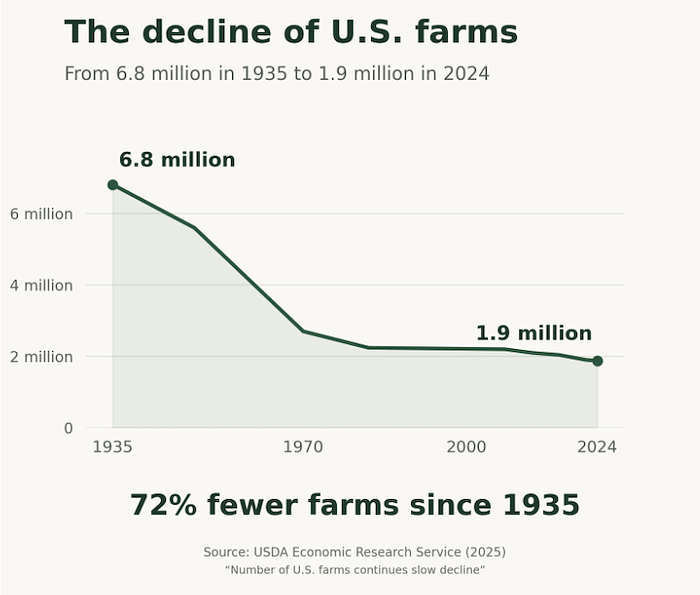
Because we’ve lost touch with where our food comes from, we’ve lost our understanding of its value, and we’ve cheapened it. As a society, we’ve become addicted to cheap food. Meanwhile we pay the real price at the doctor’s office, in our insurance premiums, and in our quality of life.
That demand for cheap food has pushed farmers to grow food faster, fatter, and cheaper than ever before.
In the 1970s, Nixon’s Secretary of Agriculture, Earl Butz, told farmers to “get big or get out.” For 60 to 70 years, this downward pressure has driven family farms to their economic and ecological breaking points.
I lived this growing up on a conventional farm, as I’ve shared before. Our family was caught in that vicious cycle, and we were suffering for it. None of us brothers wanted to take over the family farm, because we didn’t want to stay dirt poor.
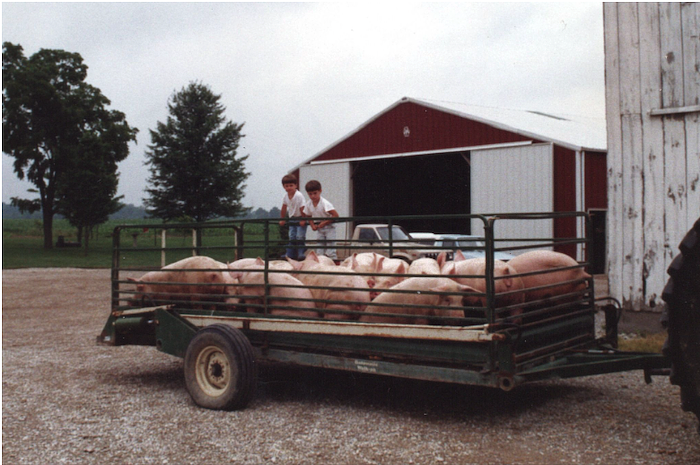
(Photo taken in the '90s of my brother Blake and I helping my dad load market hogs destined for Tyson Foods. Little did we know the hog price was about to collapse which led to thousands of American hog farmers going out of business.)
This story has played out on family farms across the country for decades. And it’s leading directly to the second disconnection.
The disconnection between land ownership and stewardship.
Because family farms aren’t passing the land to the next generation, American Farmland Trust estimates that nearly 300 million acres could change hands in the next 20 years. That’s roughly one third of all the farmland in America.
So if the next generation isn’t inheriting the land, who is buying it??
You don’t have to look far. Corporate land buying is happening at an unprecedented rate. Since 2008, the value of farmland held by the largest investment firms has jumped more than 800%.
Bill Gates alone owns over a quarter of a million acres of land and officially earned the title of America's largest private farmland owner in January 2021
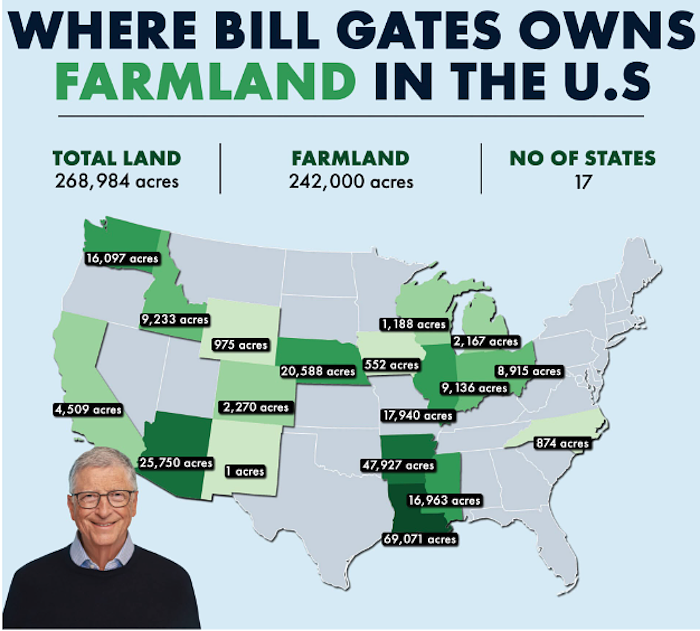
We’re heading toward an ever-increasing disconnect between the owner of the land and the farmer who works it.
That. changes. everything.
A farmer who owns his land makes long-term decisions for the good of his soil, his farm, and his future generations. A private equity firm that owns land has one priority: the highest possible return.
Here’s where the first two forces converge…
Cheap food is already squeezing farmers from the top down. Now, corporate landowners will squeeze them from the bottom up, leasing land to the highest bidder, year after year. That only drives more consolidation, more cost-cutting, and more corner-cutting.
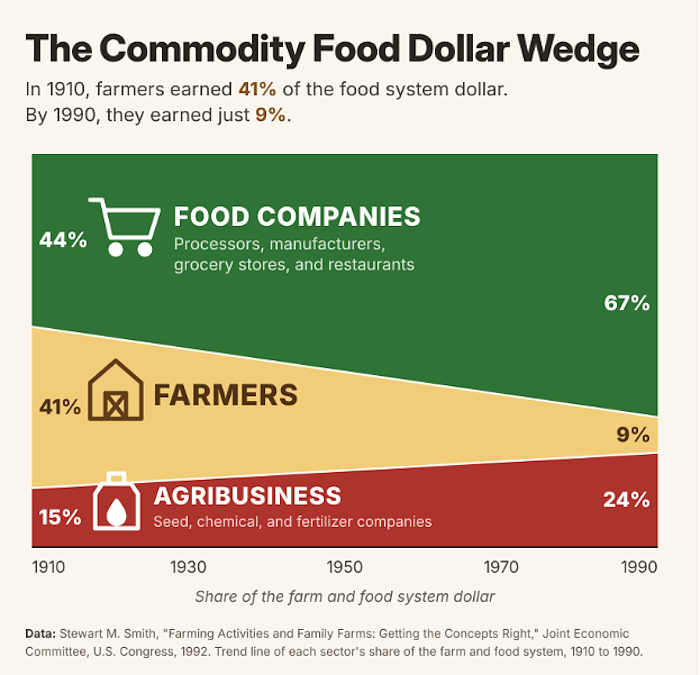
I created the above graph using AI to show you how farmers have been squeezed from both the top down and the bottom up for decades. I call this the ever-narrowing food dollar wedge.
Regenerative agriculture requires long-term thinking. If you want your land to produce abundantly and economically, there’s no way to do it without managing it over many years. But a farmer can’t afford to invest in soil he may not be farming next year.
If that isn’t concerning enough, there’s a third disconnection that threatens our very national sovereignty.
The disconnection between a country and its food supply.
The first two forces have created a frenzy of attention from foreign investors. Never before has so much American farmland come up for sale, and the world has noticed. This may be a once-in-a-nation’s-lifetime transfer of land, and the auction arena is filling up with global bidders.
According to the USDA, foreign-held interests in U.S. land have surged.
In 2010, foreign investors held roughly 24.2 million acres; by recent counts, that number has climbed to over 46 million acres. Since 2017, the rate of acquisition has practically quadrupled, to as much as 3 million new acres per year..
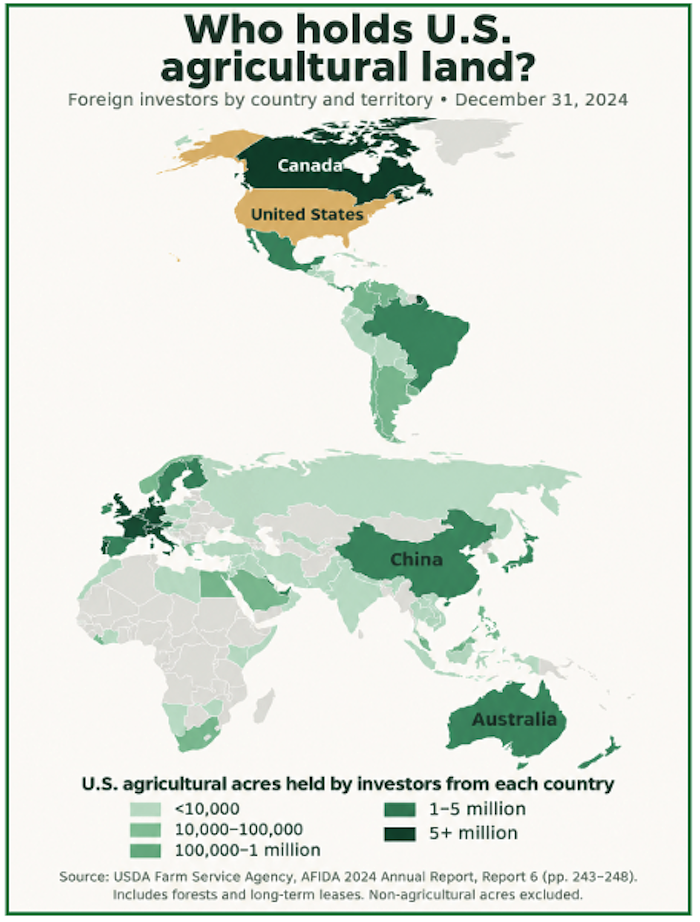
I’m calling this The Silent Sellout of American Soils.
Our government knows this is a major problem, as legislators in 29 states have passed laws attempting to limit certain foreign adversaries from purchasing more land. However, this legislation still allows for continued foreign investment and does nothing to address the root cause of all this.
I’m not a doomsdayer or an alarmist. These are real trends, and they’re speeding up, not slowing down. I won’t make predictions about how far this goes. But it concerns me that it’s already happening at this scale, and nobody seems to be connecting the dots.
And I’m not one to spend time explaining a problem unless I believe there’s hope for a solution.
Thankfully, American farmers still own the majority of land in the U.S. There IS hope. But the time to lead and act is now.
We see a clear path out of this, and it’s exactly what we’re about here at Seven Sons. We can’t single-handedly change the food system, but we can be a lighthouse. We can light the way forward and show a better model for the future.
In my next blog, I’ll show you why some of the solutions being proposed are actually making matters worse. Then I’ll lay out how we’re locking arms with you to build a working model of a food system that can end this Silent Sellout of American Soils.
Thank you for reading, for caring about where your food comes from, and for standing with family farms like ours. It means more than you know.
- Blaine
Sources
- American Farmland Trust: Farm Legacy Program
- CSG Midwest: Farmland at a Crossroads: Ownership, Investment and Use
- USDA FSA: Foreign Holdings of U.S. Agricultural Land Through December 31, 2010
- USDA FSA: Foreign Holdings of U.S. Agricultural Land Through December 31, 2024
- American Farm Bureau: Foreign Ownership of U.S. Agricultural Land Still Growing
- National Agricultural Law Center: Foreign Ownership State Update, July 2026
- Farm Week: USDA rule targets foreign ag land buys
- Grist: The Butz Stops Here
- USDA: Shrinking number of farms in the USA